

Archipelago Educators Meeting XIII

You can do more than 1 Learning Mission.
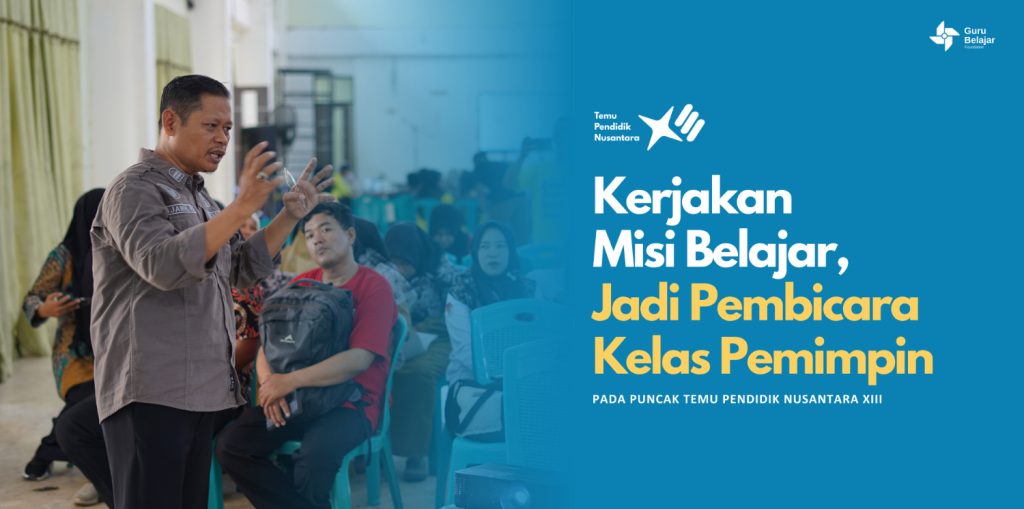
Immediately carry out your mission to learn to become a speaker.
Announcements of speakers will be made periodically from September-October 2026.
The final deadline for completing the study mission is:
30 September 2026

At the beginning of the school year, Mr Rahmat did not immediately open the meeting with a target value. As a school principal, Instead, he brought a map of the area and several notes from community meetings.
“If we are honest,” he said to the teachers, "What problems do residents around this school feel most??”
The meeting room was silent for a moment. Then various answers emerged: children drop out of school because they have to work, remote access to health, unmanaged waste, parents who have difficulty finding permanent employment.
Pak Rahmat did not ask for a quick solution. He invited the team to see the difference between administrative targets and public challenges. Targets can be achieved with short programs. Citizen challenges require alignment, time, and consistency.
“If our school chooses this one issue as a direction,"He continued, "what do we need to change in the way we plan learning, partner, and assess success?”
Since that, schools are starting to open dialogue spaces regularly, not just with teachers, but also with parents, local people, and village head. This dialogue is not positioned as one-way socialization, but rather as a way for schools to continually read the changing needs of citizens and test the relevance of their learning direction.
From that process, The school's orientation is slowly shifting. Learning projects are designed not to simply meet indicators, but to understand the real problems of citizens. Partnerships are not built for the sake of fame, but rather so that students and teachers learn to be present in ongoing social processes.
School success is no longer only read from numbers, but from a more honest question: does this school help residents understand the problem, amplify their voices, and opens up the possibility of change?
For Mr Rahmat, Educational leadership means having the courage to choose: make public challenges the school's compass, although the road is not always neat, fast, or easy to report.
Have you ever resolved the challenges faced by Mr. Rahmat??
After several times opening a space for dialogue with parents and residents, Mrs. Ratna realized one thing. The problems that arise do not stand alone. Children's health problems, waste management, so that the lack of safe space for teenagers is interrelated and becomes a common challenge for the village.
He then invited the village head, community health center representative, waste bank manager, and youth figures sat at one table. Not to ask for school program support, but to ask, "What issues are most pressing for residents and we can learn about them together through school?”
From this conversation, one public challenge emerged: managing the village environment which has an impact on the health and livelihood of residents. This challenge is not left to one party. School, village government, and the community agreed to make it a common agenda.
The school then translates the community's challenges into project-based learning across subjects. Students conduct field research, dialogue with traders and health workers, as well as documenting existing practices in the village. The village government opens up data and access. Community assists in the field.
Student learning outcomes do not stop in the classroom. Their findings were discussed again with residents and village officials as a basis for improving ongoing programs. Some recommendations are even included in the village work plan for the following year.
In this process, schools no longer exist as institutions busy with internal targets. It serves as a learning space, a place where public challenges are read together, knowledge is gathered across sectors, and learning directed to strengthen life together.
Mrs. Ratna summarized this direction in one simple sentence at the school meeting, “If the school chooses to side with the community's challenges, then learning is never separated from life.”
Have you ever resolved the challenges faced by Mrs. Ratna??
This is City, principal of secondary schools in coastal areas, very anxious. So far, the students have been good at doing their assignments and achieved high test scores, but less sensitive to community issues. They say answer questions, but awareness has not yet grown to develop their own region - even though the village has so much potential.
He took that worry to a meeting with the teachers. They then read and discussed the direction of regional development in the Regional Medium Term Development Plan (RPJMD), which emphasizes food security and strengthening the local economy. The question is simple: how schools can help prepare students to be involved in it?
Teachers across subjects then design curriculum and project-based learning strategies. Students map the local food production chain, Interviewing small business actors, and compile simple findings and recommendations from their learning results.
With that plan, Mrs. Siti held an audience with the Education Department and regional heads. He offered an MoU: schools become regional learning partners through projects based on local food issues, while the government opens data access, source person, and space for policy dialogue.
School is no longer just a place to pursue values, but the space fosters real concern and contribution to the region.
Have you ever solved the challenges faced by Mrs. Siti??
At the beginning of the semester, Mr. Togar did not ask teachers to submit neat and uniform lesson plans. As a school principal, he actually invited them to come with a question they didn't know the answer to.
“What do you want to try in class this year,he said straightforwardly, "Even though the results may not be immediately visible?”
Some teachers looked doubtful. So far, they are used to being judged on obedience, not from the courage to try new things. Mr Togar emphasized his stance. You can try, fail is also possible, as long as you don't stop learning.
The school then prepared a simple assistance room. Teachers who try new approaches are asked to record the process, start from the initial plan, what really happens in class, to the changes that appear in students. These notes were discussed together in the teacher forum, not to find fault, but to understand the choice taken.
When a learning project doesn't go as expected, there is no unilateral warning. Instead, there is an open discussion about which parts need to be improved, what support is still lacking, and what's worth retrying.
Slowly, teachers become more courageous to take initiative. Students also learn that the learning process is not about always being right, but rather a matter of being responsible for the choices and efforts made.
For Mr Togar, Trust does not mean directionlessness. Trust means giving space to try, accompanied by reflection, assistance, and the courage to learn from failure as the foundation of school leadership.
Have you ever solved the challenges faced by Mr. Togar??
When the school implements a new policy on cross-subject learning projects, Mrs. Andi did not rush to establish this as a standard rule. As deputy principal for curriculum, In fact, he invited teachers to view the policy as a joint effort that needed to be undertaken and tested.
“This is not a policy that we immediately lock," he said at the teachers' meeting. "We'll do it well first, then we'll see together whether it's really helping students.”
During the first three months, teachers undertake cross-subject projects in a variety of ways. Schools don't just ask for administrative reports, but also a record of experience: how students respond, when do they seem more alive, and where teachers encounter difficulties in class.
After that, teachers gather in a reflection forum. Some said that coordination between subjects still felt difficult. Others share the finding that students are much more engaged when projects are tied to real issues around them, like the environment, family, and the daily lives of residents.
From that deliberation, schools adjust policies. Teacher collaboration times are clarified, project guidelines were lightened, and practice sharing spaces are made more organized so teachers can learn from each other.
For Mrs. Andi, policies are not just documents that must be adhered to. It is a collective learning process carried out with mutual trust, repaired together, and always directed at a more meaningful student learning experience.
Have you ever resolved the challenges faced by Mrs. Andi??
At the beginning of the school year, Mr. La Ode did not come to the meeting with a list of new programs. Instead, he asked the Head of Student Affairs to conduct a simple survey of all students about their most meaningful learning experiences, the most burdensome things, and their concerns about the future after graduation.
The survey results are mapped and discussed with the teacher. It is clear that the students most affected by the busy school agenda are those who are already vulnerable, like a student from a poor family, who have to help their parents work, or who are about to drop out of school. Many of them find school busy, but it doesn't always help them be ready to live and work.
From the student's voice, schools agree on one important thing. Learning needs to give direct experience in the field, with the community, which is really useful, not just for today, but also for the future.
Mr. La Ode then invited the teacher, parent, public figure, and village officials sat together. They did not discuss the school's program list, but rather a common problem faced by residents, like a forest that is starting to break down, children who don't have a study room after school, and the lack of job opportunities for young graduates.
From this dialogue several concrete options emerged. The school built a village reading park which is managed together with students and residents, developing food gardens and simple preparations as a learning space about nutrition and family economics, and designing small social entrepreneurship projects that provide students with work experience and earning opportunities after graduation.
To make space on this option, schools dare to release several old programs that take up learning time and burden teachers without any clear impact. The budget is diverted to activities that can be carried out across generations and do not depend on just one person.
The teachers then develop learning strategies and implementation techniques, then submit proposals to local governments and private partners with firm limits. Partnerships must not come at the expense of student needs or teacher dignity.
For Mr. La Ode, taking sides with children and the future is not a matter of adding as many good programs as possible. It is a matter of courage to choose, protect study time, prioritize the most vulnerable, and ensure that today's decisions do not rob students of their future, environment, and the lives of citizens in the years to come.
Have you ever solved the challenges faced by Mr. La Ode?
Without YA, let's help Mr. Laode, write your heart's story based on your experience, click 👉 here
When NOT, Do you want looking for a solution to Mr Laode's challenge?. Study the Action Plan Guide, click 👉 here
Pak Yusuf regularly accompanies a school that seems to be running well. Neat administration, complete program, and ongoing internal supervision.
But every time it comes back, it feels like not much has really changed.
One day, he did not immediately open the supervision instrument. Instead, he sat with the principal and deputy principal.
“According to Mr/Mrs,he asked, “Which part of learning in this school needs to be strengthened the most at this time?”
The question silenced the room.
After a while, The vice principal started talking about teachers who still had difficulty activating students. The school principal added that so far they have been more focused on ensuring the program runs, not seeing the impact in the classroom.
Pak Yusuf did not immediately give instructions. He invited them to choose a small focus to accompany them together. He also encouraged school principals and their deputies to start opening discussion spaces with teachers, not just delivering instructions.
On my next visit, what is being discussed is no longer the completeness of the program, but an ongoing process: what have you tried?, what changed, and what remains a challenge.
Big indirect changes. But slowly, The principal and his team began to more actively lead the learning process in their school. Discussions with the teacher started to become lively, teacher reflection about improving learning becomes a habit, and initiative no longer always waits from outside.
Several months later, the principal said, “We are starting to understand more about how to assist teachers, not just direct.”
From there, Mr. Yusuf realized: the role of school supervisors is not to take charge of change, but strengthening leadership within schools so that change can grow and last.
Have you ever resolved the challenges faced by Mr. Yusuf??
Mr Jati, a school superintendent, receive direction from the Department of Education regarding regional priorities: strengthening local food security. The program should immediately run in schools.
However, when visiting the assisted school, he saw things differently. Much learning still takes place in the classroom, and not yet connected to the lives of the surrounding community.
Mr. Jati saw the distance between the two. Regional programs are running on target. School goes on with its routine.
He did not directly convey instructions. He invited the principal and deputy principal to discuss.
“Food security is a regional direction,he asked, “what could change in the way schools design learning?”
That question opened a new conversation.
Schools are starting to see that the food issue is not just a program, but it can be a learning context. From there, Mr. Firman invited them to choose a first step: developing project-based learning that involves students learning directly with farmers around the school.
Pak Firman then bridged communication with related agencies and farmer groups, so that the school does not run alone. He also accompanies the principal and his team to design learning that remains appropriate to school conditions.
Big indirect changes. But things are starting to look different. Schools are no longer separated from regional needs. And district programs no longer feel like an additional burden.
Some time later, the principal said, “Now we are starting to see where this area could become part of learning, not something we have to run separately.”
From there, Mr. Firman realized: the role of the school supervisor is not only to ensure that the program is carried out, but provides a bridge so that the direction of regional development becomes part of the learning process in schools.
Have you ever resolved the challenges faced by Mr. Jati?
Invite & challenge fellow teachers!
click the button below
Each challenge can be done more than once with different answers
To carry out Learning Missions, You don't have to have exactly the same conditions as the problem raised in the mission question. As long as the substance of the problem/challenge is similar (there are similar keywords) and your experience is relevant to the substance of the problem, You can do Learning Missions.
The answer you write is to tell a real experience that you have had when facing a similar problem, not like giving normative and abstract advice.
Look for the closest Learning Mission questions. For example, your experience of Positive Discipline, but you didn't find any specific questions about that theme, You can take missions about Class Management. Need to be a note, Learning Mission questions are generally made more general so they can cover various experiences and situations experienced by teachers.
You can use the help of the Action Plan Guide if your experience does not match the mission.
For purposes as a speaker for TPN XI, The TPN committee will report the mission data that passes to the regional committee. So, The regional committee will contact the authors of the missions that pass, whether willing to be a speaker at the regional TPN XI or not. For publication purposes in the Teacher Learning Newspaper, The editorial team will send invitations to mission writers who pass to write more complete stories in accordance with editorial provisions. However, In the future, our team will provide information about PASSING or NOT on the Learning Mission website.
1. Register on the portal tpn.gurubelajar.org
2. Click Missions (then various mission options will appear).
3. Choose a mission that is appropriate or relevant to the challenges you have experienced.
4. Tell us about your maximum experience 200 say.
5. If your story has been published in certain media, You can also include the publication link.
When you do a Learning Mission, You have the opportunity to be a resource person at the Nusantara Educator Gathering, either in one of the 50 Areas in June-July and or at Puncak in 2-3 November 2024 in Jakarta.
Besides that, You also have the opportunity to be invited to write in the Teacher Learning Newspaper. The curatorial team will contact you to write a more complete story.
If your practices are good you can provide a solution for many people, You will also have the opportunity to share good practice in many educational forums, develop a career, and expand impact to the broader educational community.
Yes, if you have experienced this situation many times and handled it in different ways, You can send writing separately for each method that has been done.
Points board displays 600 guru, 120 career teacher, 120 educational leaders who are active in carrying out missions. Yuk, do the Learning Mission again, for a chance to appear on the points board.
If you experience problems scrolling, scroll outside of the area Live Chat which is black.